There are plenty of reasons why a stairlift might no longer be needed. Someone may have recovered following an operation, moved into different accommodation, or sadly the person who used the stairlift may have passed away. Whatever the circumstances, removing a stairlift is normally a relatively straightforward job when it’s carried out by an experienced stairlift engineer.
But what actually happens during stairlift removal? Will it damage the staircase? Can the stairlift be reused or sold? And should you ever try to remove one yourself? Here’s what you need to know.
Can a Stairlift Be Removed?
Yes. Stairlifts are designed so they can be removed when they’re no longer required. In most installations, the stairlift rail is attached to the stair treads rather than directly to the wall, so removing the lift doesn’t usually involve major work to the property.
The stairlift chair and carriage are removed along with the rail and its fixings. Once everything has been taken away, you’re left with the original staircase rather than a permanent mobility installation.
How Is a Stairlift Removed?
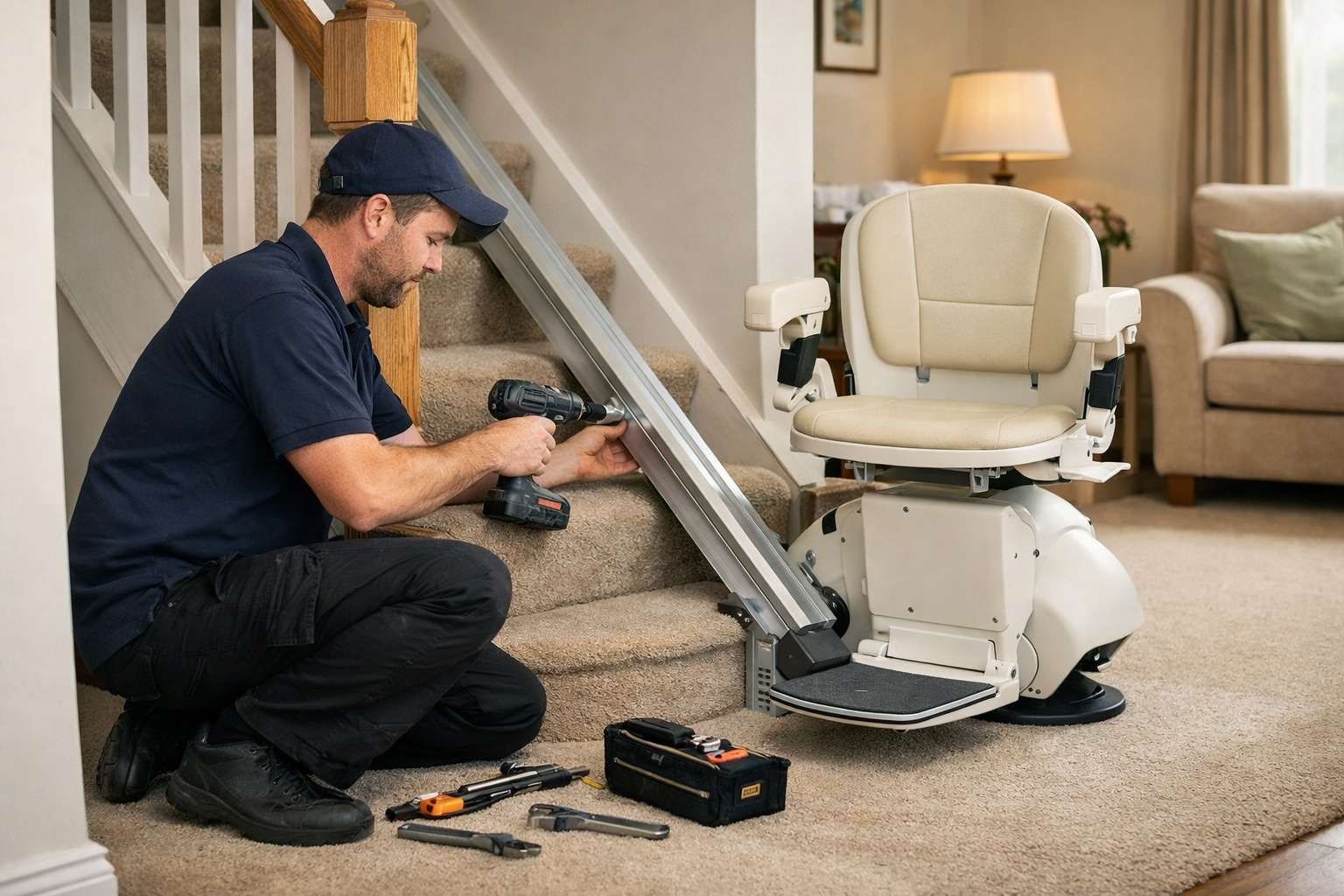
The exact process depends on the make and model, but professional stairlift removal will generally involve safely isolating the lift, removing the chair and carriage, dismantling the rail and removing the brackets that secure it to the stairs.
A straight stairlift will usually be simpler to dismantle than a curved stairlift because the rail is less complex. Curved stairlifts use rails made for the shape of a particular staircase, so they may need to be dismantled in several sections.
Does Removing a Stairlift Damage the Stairs?
Professional removal shouldn’t cause major damage to a staircase. Because stairlift brackets are normally fixed into the stair treads, rather than the wall, there may be small fixing holes or marks where the brackets have been positioned.
On a carpeted staircase, you may also notice slight differences in the carpet where the brackets have been sitting, particularly if the stairlift has been installed for several years. In many cases these marks become much less noticeable once the carpet has settled.
If you’re having a stairlift fitted and are worried about what happens to your home afterwards, our guide to what to expect when installing a stairlift explains how a typical installation works.
Can I Remove a Stairlift Myself?
We wouldn’t recommend it. A stairlift contains heavy mechanical components, rechargeable batteries and electrical connections, and some parts can be awkward to handle safely on a staircase.
There is also the question of what happens to the stairlift afterwards. If it has any potential for refurbishment or reuse, dismantling it incorrectly could damage components that might otherwise have been usable.
Having the stairlift assessed and removed professionally is generally the safest option.
How Much Does Stairlift Removal Cost?
There isn’t one standard stairlift removal price because the work involved depends on the type of stairlift, its location, the design of the staircase and what is going to happen to the equipment afterwards.
A straight stairlift is generally easier to remove than a complex curved system, while access to the property can also affect the work involved. The best approach is to have the stairlift identified first so the removal requirements can be assessed properly.
What Happens to a Stairlift After It’s Removed?
That depends on its age, make, model and condition. Some stairlifts or components may be suitable for professional refurbishment and reuse, while older or heavily worn equipment may have little or no reusable value.
This is one of the reasons it’s worth speaking to a stairlift specialist before simply disposing of an unwanted lift. A professional can assess what you have and explain the realistic options.
Can an Old Stairlift Be Reused?
Sometimes, but it depends heavily on the type of stairlift.
Straight stairlifts have more potential for reuse because their rails are relatively standard and can sometimes be adapted to another suitable straight staircase. Curved stairlifts are more complicated because the rail is designed around the bends, angles and dimensions of the original staircase.
That doesn’t necessarily mean every part of a curved stairlift is useless. Certain components may still be suitable for refurbishment, but the complete rail usually can’t simply be moved from one curved staircase to another.
What Is a Reconditioned Stairlift?
When suitable equipment can be reused, it should be properly inspected and prepared before being installed for another customer. This is very different from simply buying an old stairlift privately and arranging for somebody to fit it.
Top Flight’s reconditioned stairlifts are professionally checked, serviced and tested before installation. Prices start from £1,100 supplied and fitted, with a 12-month warranty and service included.
If you’re considering a used stairlift because of the potential savings, read our second hand stairlift buying guide before buying privately. It explains some of the important differences between an unknown second hand stairlift and one that has been professionally reconditioned.
What If You’re Renting the Stairlift?
If the stairlift is rented, removal is much simpler from the customer’s point of view because you don’t own the equipment.
With Top Flight’s stairlift rental service, when you no longer need the stairlift we arrange to collect it free of charge. This can make rental particularly useful when a stairlift is only needed temporarily and you don’t want to worry about selling or disposing of it afterwards.
Can You Sell a Stairlift You No Longer Need?
Potentially, although it’s important to have realistic expectations. The value of a used stairlift depends on its age, condition, manufacturer, model and whether it can realistically be reused.
A stairlift that originally cost several thousand pounds won’t necessarily have a high second hand value. Part of the original price covers surveying, manufacture or rail preparation, professional installation and other work that can’t simply be transferred to a new owner.
Curved stairlifts can be particularly difficult to sell privately because their rails were designed for a specific staircase.
What If the Stairlift Belonged to Someone Who Has Died?
If you’re dealing with a stairlift following a bereavement, you don’t need to know the technical details of the equipment before asking for help. The make and model can usually be identified from the stairlift itself, allowing an installer to advise on removal and whether any part of the system may be suitable for reuse.
There’s also no need to rush into dismantling or disposing of it yourself. Having it assessed first can make the process much easier.
Need a Stairlift Removed?
If you have a stairlift that’s no longer required, the safest starting point is to speak to an experienced stairlift company. They can identify the lift, assess how it needs to be dismantled and explain what can realistically be done with it afterwards.
If you’re replacing an existing stairlift because it’s becoming unreliable or unsuitable, it may also be worth considering a professionally reconditioned stairlift as a lower-cost alternative to buying brand new.
Contact Top Flight Stairlifts if you’d like to discuss an existing stairlift and the options available.
Got a question about your stairlift?
Whatever you’re trying to work out, our team gives honest advice with no pressure – get in touch and we’ll help however we can.